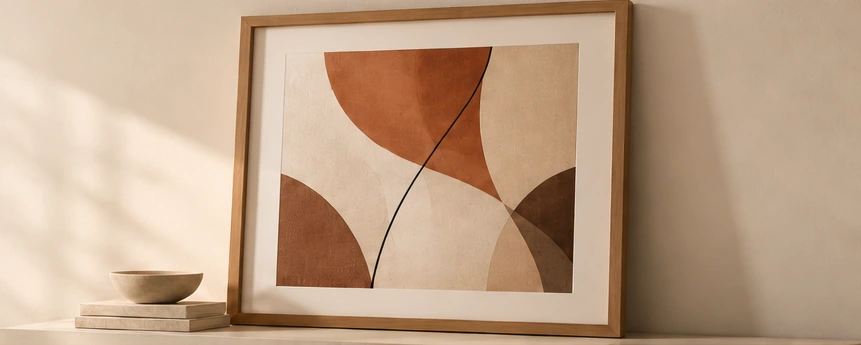
Too small, a picture gets lost on a large wall; too big, it overwhelms the room. Yet a few simple guidelines are all you need to get it right, whether you are decorating a living room, a bedroom or an entrance hall.
The two-thirds rule
Above a piece of furniture (a sofa, a sideboard, a headboard), the picture, or group of pictures, should take up about two-thirds of the furniture's width. Less than half, and it looks lost; more than three-quarters, and it seems to spill over.
- A 2 m sofa: aim for about 1.30 m wide, for example two 50 × 70 pieces in portrait side by side (1.15 m with the gap between them), or the largest size, a 70 × 100 in landscape (1.09 m with the wide frame).
- A 1.60 m headboard: about 1.05 m, such as a 70 × 100 in landscape (1.03 m with the slim classic frame).
- A 1.50 m sideboard: about 1 m, for example two 40 × 50 pieces side by side (43 cm each with the slim classic frame).
- A 1 m console table or chest of drawers: about 65 cm, so a 50 × 70 in portrait (53 cm with the slim frame, 59 cm with the wide frame).
Think in terms of the framed size
The size quoted is that of the frame: the opening the artwork sits in. The frame adds its moulding: 3 cm for the slim classic frame (1.5 cm on each side), 9 cm for the wide wooden frame. The mount does not change the size of the picture: it sits inside the frame, and the artwork is printed slightly smaller. A 50 × 70 with a slim classic frame therefore measures 53 × 73 cm on the wall, with or without a mount.
| Size | Framed, with or without a mount | Where to hang it |
|---|---|---|
| 10 × 15 cm | 13 × 18 cm | Shelf, desk, gallery wall |
| 13 × 18 cm | 16 × 21 cm | Bedside table, gallery wall |
| 18 × 24 cm | 21 × 27 cm | Narrow entrance hall, bathroom, gallery wall |
| 20 × 30 cm | 23 × 33 cm | Hallway, kitchen, as a series |
| 30 × 40 cm | 33 × 43 cm | Bedroom, study, above a console table |
| 40 × 50 cm | 43 × 53 cm | Above a chest of drawers, as a pair above a sofa |
| 50 × 70 cm | 53 × 73 cm | Above a sofa or a bed |
| 70 × 100 cm | 73 × 103 cm | Large living-room wall, statement piece |
Room by room
- Living room: often the largest wall in the house. A 50 × 70 or a 70 × 100 above the sofa, or two identical sizes side by side.
- Bedroom: above the bed, keep to the two-thirds rule, based on the width of the headboard. A landscape format echoes its horizontal line.
- Entrance hall and hallway: you pass very close to the wall, and up close, medium sizes (20 × 30, 30 × 40) are easier to take in. A series of frames hung in a line gives a hallway rhythm.
- Study: a 30 × 40 or a 40 × 50 facing you, to rest your eyes between screens.
- Kitchen and bathroom: small sizes, away from splashes and sources of heat.
Portrait or landscape?
Follow the shape of the wall and the furniture. Above a sofa or a bed, landscape extends the horizontal line; between two windows, on a narrow stretch of wall or along a staircase, portrait makes the room feel taller. Every artwork can be created in portrait or landscape.
What about viewing distance?
The further back you stand from a picture, the larger it can be. A handy guideline: an artwork is comfortable to look at from one and a half to two times its diagonal. A 50 × 70 framed with a mount (a diagonal of about 1.10 m) is therefore best enjoyed from 1.60 m to 2.20 m away, the typical distance between a sofa and the wall opposite.
Torn between two sizes? Choose the larger one: on the wall, an artwork almost always looks smaller than you imagined. For the hanging height, see our guide on how high to hang a picture.